

From the heart-stopping leaps of "spider-men" on hundred-meter skyscrapers to the maintenance headaches beneath photovoltaic panels in "fishery-solar" hybrid installations—since 2026, drone cleaning technology has been making a significant impact on building facades and new energy facilities across the country. This marks the transition of the "efficient, safe, and eco-friendly" drone cleaning model from concept validation to large-scale commercial deployment.
In traditional high-altitude cleaning, manually washing a hundred-meter skyscraper often takes several days and carries extreme risks. Today, this paradigm is being disrupted by drones.
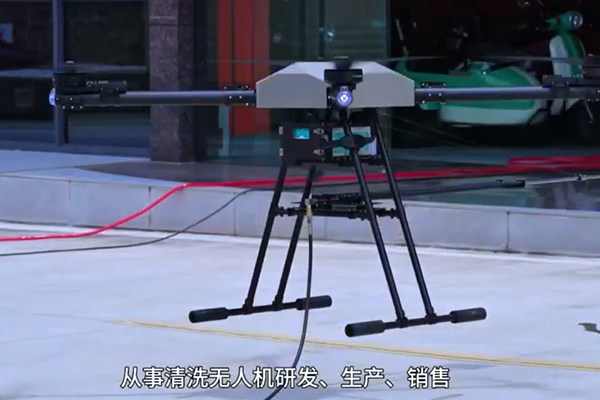
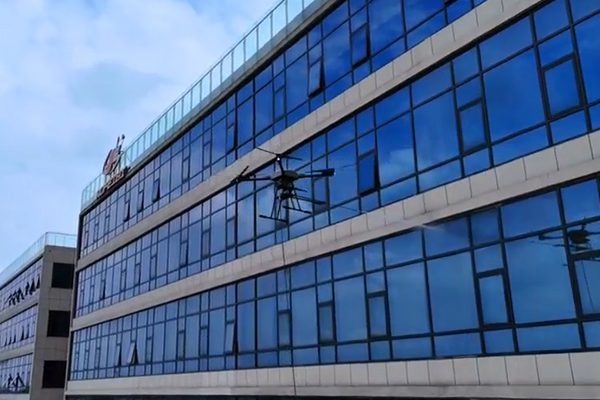
According to industry application data, professional cleaning drones can complete facade cleaning of tens of thousands of square meters in just over ten hours. Compared to traditional manual methods, efficiency improves by 5 to 20 times, water consumption is reduced by over 60%, and overall costs are only 70% of manual labor. Equipped with centimeter-level dual-RTK positioning systems and full-coverage obstacle avoidance radar, these drones can precisely adapt to irregularly shaped facades, ensuring streak-free cleaning.
In real-world case studies, cleaning a 20,000+ square meter building exterior that would traditionally require a week of "spider-man" labor can now be completed by drones in less than two days, achieving a cleaning coverage rate of up to 99.8%, with significant water savings. Office buildings, commercial complexes, and public venues across multiple regions have begun adopting drone cleaning solutions on a regular basis. Operations have expanded from single-unit trials to multi-drone coordinated fleet operations, further boosting cleaning efficiency. Currently, this drone cleaning service has extended from pilot programs to widespread adoption in North, East, and South China, with market demand continuing to rise.
Beyond urban architecture, drone cleaning has also achieved breakthrough progress in industrial and energy applications, effectively addressing challenges such as high labor intensity, safety risks, and lost power generation revenue.
For complex scenarios like "fishery-solar" hybrid power stations, photovoltaic modules are exposed to the elements for extended periods, where bird droppings and dust accumulation can cause power generation efficiency losses exceeding 20%. Traditional manual cleaning requires over 20 workers and nearly two weeks of labor. Moreover, photovoltaic panels installed above fish ponds, water surfaces, or steep slopes pose significant risks of drowning and electric shock. Professional cleaning drones, equipped with intelligent route planning systems, can efficiently complete cleaning of megawatt-scale photovoltaic arrays, completely eliminating personnel safety risks while rapidly restoring power generation efficiency.
In power facility maintenance, drones have proven equally impressive. Heavy-lift multi-rotor drones can perform live-line water flushing on insulators of high-voltage transmission lines, cleaning a single insulator string in just minutes, with overall efficiency improved by more than 60%, avoiding the economic losses associated with traditional outage-based maintenance.
Current drone cleaning technology has achieved multiple breakthroughs:
Precision Positioning: RTK differential positioning combined with visual recognition technology enables drones to maintain centimeter-level hovering accuracy even under strong wind interference.
Intelligent Planning: Autonomous route planning systems based on building BIM models or 3D maps of photovoltaic stations can generate optimal cleaning paths with a single click, enabling fully automated operations.
Eco-Friendly Cleaning: Closed-loop water circulation systems and wastewater recovery devices effectively prevent cleaning fluid from dripping onto ground surfaces, meeting urban environmental protection requirements.
As technology matures and costs decline, drone cleaning is expanding from building facades to more scenarios, including photovoltaic panels, power plants, bridges, and even wind turbine blades.
Industry observers point out that at this stage, drones will not completely replace "spider-men," but human-machine collaboration has become an industry trend. For equipment manufacturers, providing customized solutions for different scenarios (such as pure water for power sector applications and eco-friendly cleaning agents for building applications), along with exploring flexible business models like "rent-to-own" or "pay-per-service," will be key to capturing this blue-ocean market.

sales@skydronetech.com

+86-18705999723

غرفة 12-2328، المبنى رقم 1، شارع شينجلي الشرقي 5051، مدينة وي فانغ، مقاطعة شاندونغ، الصي


حقوق الطبع والنشر لشركة Shandong Sky Intelligence Technology Co. ، Ltd. جميع الحقوق محفوظة.
سياسة الخصوصية
يستخدم هذا الموقع ملفات تعريف الارتباط لضمان حصولك على أفضل تجربة على موقعنا.
 English
 Español
 Français
 Deutsch



 واتس اب
 هاتف
 صندوق البريد
 رسالة
تعليق
(0)